
Guida
Come catalogare una collezione di monete
Il metodo, in cinque passi
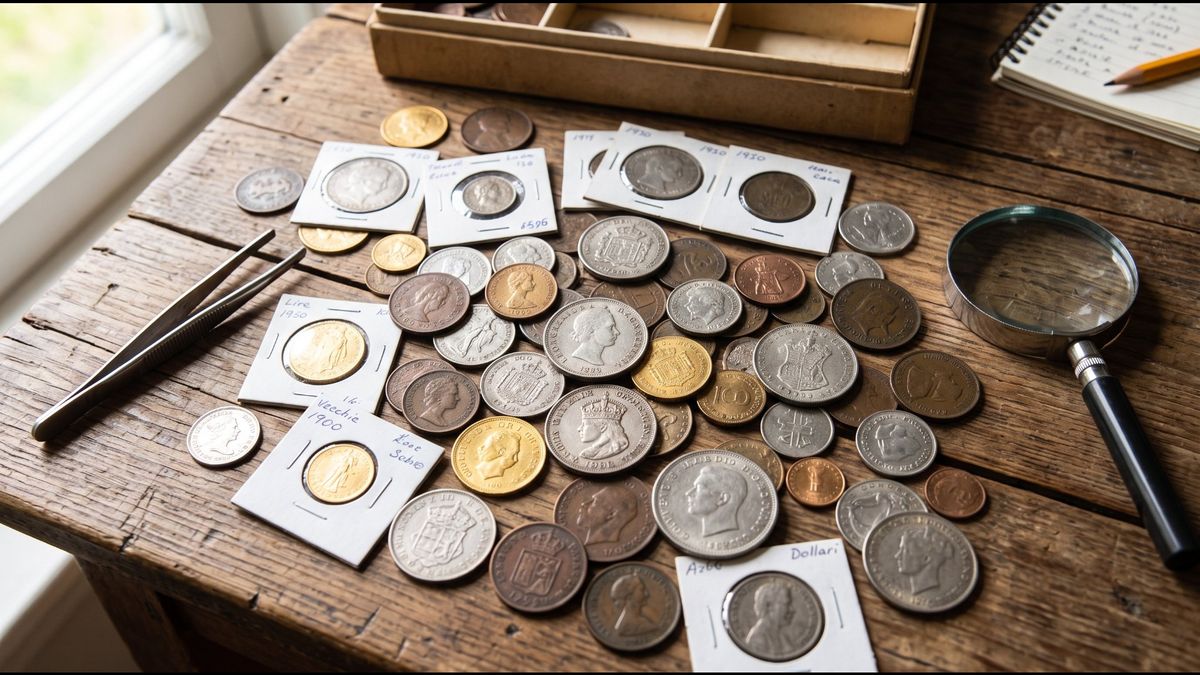
Hai una scatola di monete e non sai da dove cominciare. Oppure hai un raccoglitore pieno e non riesci più a trovare niente. Il metodo è lo stesso nei due casi, e non serve essere esperti: serve decidere poche cose e poi tenerle.
1. Il codice e il posto
Prima dei campi, prima del programma, prima di tutto: ogni moneta ha bisogno di un codice e di un posto.
- Il codice è tuo: lo decidi tu e non cambia mai più. Una
forma semplice come
MON-0001va benissimo. - Il posto è dove sta fisicamente: raccoglitore, pagina, scomparto.
Con questi due, una moneta la ritrovi in dieci secondi anche fra dieci anni.
⚠️ Nel codice non mettere il paese, l'anno o la zecca. Sembra comodo —
IT-1923-01 dice tutto a colpo d'occhio — ma con le monete le attribuzioni si
correggono, e succede spesso. Appena ti accorgi che quella moneta non è quella che credevi, il
codice diventa falso, e devi rifarlo dappertutto: schede, etichette, foto.
Il codice è un numero, non una descrizione. Il paese e l'anno stanno nei loro campi, dove puoi correggerli senza rompere niente.
2. Cosa registrare per ogni moneta
Non serve registrare tutto. Una dozzina di campi scelti bene batte cinquanta campi vaghi, perché i campi che poi non aggiorni non servono a niente.
- Il codice (vedi sopra)
- Autorità emittente — chi l'ha battuta. Se è un'entità storica, tienila con il suo nome originale e metti il paese di oggi in un campo separato: chi ha emesso la moneta e lo Stato che oggi occupa quel territorio non sono la stessa cosa.
- Anno (o periodo)
- Denominazione e valore nominale
- Zecca e segno di zecca, quando ci sono
- Materiale, diametro in millimetri, peso in grammi e bordo
- Stato di conservazione — e tienilo separato da un'eventuale certificazione professionale: sono due cose diverse, e confonderle fa credere che una moneta valga più di quanto vale
- Foto: dritto, rovescio e bordo
- Dove l'hai presa, quando e quanto l'hai pagata
- Quanto vale — e segna l'anno del listino da cui l'hai preso: i valori cambiano, e fra cinque anni un numero senza anno non dice niente
- Varianti e note
3. La trappola: le attribuzioni incerte
Con le monete capita di non sapere cosa si ha in mano. Non forzare l'attribuzione. Metti uno stato come «da verificare», scrivi l'ipotesi e annota quali elementi ti mancano per decidere.
Una scheda che dice «forse» è più utile di una che dice una cosa falsa: la prima la correggi quando scopri di più, la seconda la credi e sbagli.
E quando trovi l'attribuzione giusta, non cancellare quella vecchia: scrivi la data, il motivo e la fonte. Fra due anni ti servirà sapere perché avevi cambiato idea.
4. Le tre regole che tengono in piedi tutto
Queste contano più dei campi.
- Prima di riporre una moneta, registrala. È la regola che salva tutto. Se rimandi, dopo due mesi hai il raccoglitore pieno e un elenco che non corrisponde più — e a quel punto smetti di aggiornarlo.
- Tieni separati i doppioni, quelle da identificare e quelle in attesa di verifica. Sono tre mucchi diversi, e mescolarli è il modo più veloce per non capirci più niente. Nel catalogo dagli uno stato, così li ritrovi.
- Un giro di controllo ogni tanto. Cerca i codici doppi, le schede senza foto, le posizioni che hai cambiato e le monete ancora segnate «da verificare». Un'ora ogni tanto, e non arrivi mai al disastro.
5. A cosa serve tutto questo
Non è ordine fine a se stesso. Serve a quattro cose concrete:
- Non comprare due volte la stessa moneta. Succede a tutti, ed è la cosa che fa più arrabbiare.
- Sapere cosa hai e quanto vale. Per curiosità, ma anche per l'assicurazione: se succede qualcosa, senza elenco non ti rimborsano.
- Essere pronto se un giorno vendi. Un elenco ordinato vale soldi: chi compra paga di più se sa cosa sta comprando.
- Confrontare due esemplari simili a distanza di anni. È il vantaggio che vale solo per le monete: le misure e le foto del bordo sono quello che ti permette di distinguere una variante dall'altra senza doverle riavere in mano. Se non le hai scritte, quella differenza è persa per sempre.
6. Chi scrive
Non sono un collezionista di monete — quindi da me non aspettarti quali sono i pezzi rari o come si riconosce un falso, non è il mio mestiere. Faccio il magazziniere: di mestiere tengo in ordine le cose, le conto, le cerco e le ritrovo. Questo metodo viene da lì, e vale per le monete come per tutto il resto.
Se preferisci farlo con un programma invece che con un foglio di calcolo, ne ho fatto uno: si chiama Thesaura, è per Windows, e serve proprio a questo. Si può provare gratis fino a 15 oggetti.
Le altre guide
Guide
How to catalogue a coin collection
The method, in five steps
You have a box of coins and no idea where to start. Or an album that is full and where you can no longer find anything. The method is the same in both cases, and you do not need to be an expert: you need to decide a few things, and then keep to them.
1. The code and the place
Before the fields, before the software, before anything else: every coin needs a code and a place.
- The code is yours: you decide it and it never changes.
Something simple like
COI-0001is perfect. - The place is where it physically is: album, page, compartment.
With those two, you can find a coin in ten seconds, even ten years from now.
⚠️ Do not put the country, the year or the mint in the code. It looks
convenient — IT-1923-01 tells you everything at a glance — but coin attributions
get corrected, and often. The moment you realise that coin is not what you thought, the code
becomes false and you have to redo it everywhere: records, labels, photos.
The code is a number, not a description. Country and year live in their own fields, where you can fix them without breaking anything.
2. What to record for each coin
You do not need to record everything. A dozen well-chosen fields beat fifty vague ones, because fields you never update are worth nothing.
- The code (see above)
- Issuing authority — who struck it. If it is a historical entity, keep its original name and put today's country in a separate field: the authority that issued the coin and the state that now occupies that territory are not the same thing.
- Year (or period)
- Denomination and face value
- Mint and mint mark, when present
- Metal, diameter in millimetres, weight in grams and edge
- Condition — and keep it separate from any professional certification: they are two different things, and mixing them up makes a coin look worth more than it is
- Photos: obverse, reverse and the edge
- Where you got it, when, and what you paid
- What it is worth — and note the year of the price list you took the figure from: values change, and in five years a number without a year tells you nothing
- Variants and notes
3. The trap: uncertain attributions
With coins, it happens that you do not know what you are holding. Do not force the attribution. Use a status like «to be verified», write down the hypothesis, and note which elements you are missing to decide.
A record that says «perhaps» is more useful than one that says something false: you correct the first when you learn more, you believe the second and get it wrong.
And when you find the right attribution, do not delete the old one: write the date, the reason and the source. In two years you will want to know why you changed your mind.
4. The three rules that hold it all together
These matter more than the fields.
- Before you put a coin away, record it. This is the rule that saves everything. Put it off and, two months later, the album is full and the list no longer matches — and at that point you stop updating it.
- Keep duplicates, unidentified pieces and pieces awaiting verification separate. They are three different piles, and mixing them is the fastest way to lose track of everything. Give each one a status in the catalogue, so you can find them.
- Check the catalogue now and then. Look for duplicate codes, records with no photos, places you have moved, and coins still marked «to be verified». An hour every so often, and you never end up with a mess.
5. What it is actually for
It is not tidiness for its own sake. It is for four concrete things:
- Not buying the same coin twice. It happens to everyone, and it is the thing that annoys you most.
- Knowing what you have and what it is worth. Out of curiosity, but also for insurance: if something happens, without a list you get nothing.
- Being ready if you ever sell. An organised list is worth real money: a buyer pays more when they know what they are buying.
- Comparing two similar pieces years apart. This is the advantage that is unique to coins: measurements and photos of the edge are what let you tell one variant from another without holding them again. If you did not write them down, that difference is lost for good.
6. Who is writing
I am not a coin collector — so do not ask me which pieces are rare or how to spot a fake, that is not my trade. I work in a warehouse: my job is keeping things in order, counting them, looking for them and finding them. This method comes from there, and it works for coins as it does for anything else.
If you would rather do this with a program than with a spreadsheet, I made one: it is called Thesaura, it is for Windows, and this is exactly what it is for. You can try it free with up to 15 items.